Overview
In today’s post we will be covering different ethnographic qualities and national standings of both Fiji and New Caledonia. We will do this by discussing the countries languages, national memberships, and GDP. Now, despite the fact that New Caledonia and Fiji are so close know that due to New Caledonia’s position with France, which is discussed in blog post one, it and Fiji have very different outcomes in regard to all the topics that we will be discussing today.
GINI Explained– “GINI index measures the extent to which the distribution of income (or, in some cases, consumption expenditure) among individuals or households within an economy deviates from a perfectly equal distribution.” GINI index of 0 represents perfect equality, while an index of 100 implies perfect inequality.
*I was not able to find the countries rank when looking at GDP based on PPP but was able to find the country’s highest and lowest GDPs based on PPPs.
New Caledonia
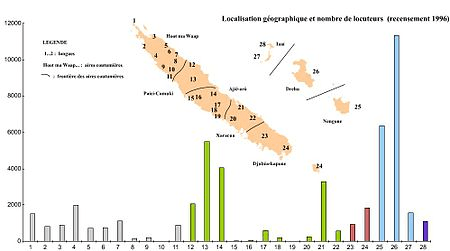
After doing extensive research I came to learn that New Caledonia has a total of 39 individual languages. “Of these, 38 are living and 1 is extinct.” You could look at this and argue that due to the globalized world it’s no surprise that there are so many languages, but what is interesting is the fact that “34 are indigenous and 4 are non-indigenous”. These results lead us to believe that a majority of New Caledonians speak more than one language as 99% speak French, 500+ speak Chinese, 5,000 speak Tahitian, and 2,360 speak Vietnamese. Which likely makes French the states language. When asked the question “Are there indigenous languages and what problems do they pose?” You could easily answer yes and proceed to say that they are making it more difficult for older generations to understand the events occurring around them, but I feel like there is more to it. When it comes to the 34 “living” indigenous languages it’s hard to believe that they would cause much issue. With 99% of the population knowing French most of the country is still able to effectively communicate so what these other languages do is simply add culture and charter to the country of New Caledonia. Where the issue is, is with the 3 developing languages in the country (Chinese, Tahitian, Vietnamese). I say this because as these developing languages grow we are learning that 24 of the indigenous languages are “in trouble” and that 8 are “dying”. So, is it really the indigenous languages of New Caledonia that are causing the “problems”?
International Organizations/Roles
As we know “New Caledonia is a Non-Self- Governing Territory under the administration of France.” The countries decolonization process started taking place in 1998 and its implementation is being monitored by the Committee of Signatories.
The committee consist of 4 members: Cuba, Indonesia, Iraq, and Papua New Guinea and met on March 12-19 of 2018. They had good results with the only issue being that the entire process of decolonizing is still very fragile.
GINI – N/A
GDP PPP
All time high 2009 (41,942)
Record low 1960 (1734.72)
Fiji
Fijis language situation is much easier than that of New Caledonia due to the fact that “The 1997 Constitution of Fiji establishes English, Fijian, and Hindustani as its official languages.”
Fijian– Used by 450,000 first-language speakers indigenous Fijians and 200,000 second-language speakers
Fiji Hindi (Hindustani)– Spoken by 350,000 in Fiji

International Organizations/Roles
Due to Fijis independence the country is much more involved than New Caledonia
WTO- Joined Jan. 14, 1996
GATT- Joined Nov. 16, 1993
IMF– Joined May 28, 1971
UN
“Fiji established its Permanent Mission to the United Nations on 13 October 1970, three days after obtaining its independence from the United Kingdom.”
“Fiji’s participation in the UN has been notably primarily for its active role in UN peacekeeping operations, which began in 1978.”
They were also the first Pacific Island to join the UN
GINI
The below index results show that with time those in the country are experiencing more equality
2002- 38.10
2013- 36.40
GDP based on PPP
All time high 2017 (8703)
Record low 1991 (5678.9)
References
(https://www.indexmundi.com/facts/fiji/indicator/SI.POV.GINI)
(https://tradingeconomics.com/fiji/gdp-per-capita-ppp)
(https://tradingeconomics.com/new-caledonia/gdp-per-capita)
https://www.radionz.co.nz/international/pacific-news/352337/un-team-visits-new-caledonia
https://www.un.org/press/en/2018/gacol3316.doc.htm
http://www.foreignaffairs.gov.fj/news-release/10-foreign-policy/foreign-policy/5-peacekeeping

 Globalization and Technologies in Oceania